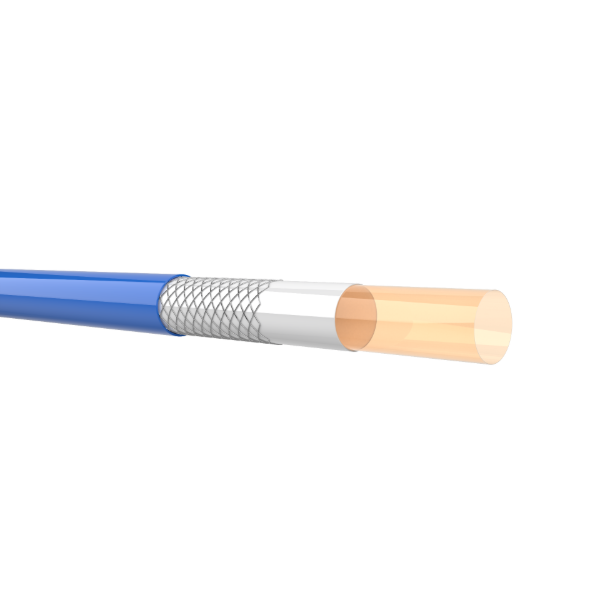
A hydrophilic coating is a thin polymer film that absorbs and retains large amounts of water. Upon contact with water or blood, hydrophilic groups on the coating surface bind with water molecules through hydrogen bonding, forming a firmly anchored hydrated lubricious layer that makes the device surface extremely smooth.
The term "hydrophilic" originates from Greek, meaning "water-loving." This property enables the coating to deliver optimal lubricity in the moist in vivo environment, making it an ideal surface modification solution for minimally invasive interventional devices.
In minimally invasive interventional procedures, catheter performance directly affects procedural success and patient safety:
1. Vascular navigability: The catheter must traverse tortuous vascular pathways to reach the target site.
2. Tissue protection: Minimizing mechanical trauma to the vascular intima.
3. Procedural efficiency: Good pushability reduces procedure time.
4. Patient comfort: Reducing surgical trauma and postoperative complications.
5. Clinical outcomes: Precise catheter control improves therapeutic results.
Surface friction is the critical variable affecting all of the above. Friction between an untreated catheter surface and the vessel wall can lead to significant problems such as difficult advancement, vascular injury, and thrombus formation.
Surface modification technology systematically improves device surface performance by applying functional thin films:
• Friction reduction: Converting solid-solid friction into liquid-liquid friction.
• Biocompatibility: Mimicking natural tissue interfaces.
• Antithrombogenicity: Reducing thrombus formation.
• Durability: Maintaining stable performance throughout the procedure.
Hydrophilic coating is one of the most successful and widely adopted surface modification technologies available.
The core components of hydrophilic coatings are hydrophilic polymers. The most common include:
Polyvinylpyrrolidone (PVP):
• The most widely used hydrophilic coating base material.
• Contains highly polar amide groups that form hydrogen bonds with water molecules.
• jMedtech's jAqua® UV-curable hydrophilic coating is based on a PVP system.
Polyvinyl alcohol (PVA):
• Excellent film-forming properties and hydrophilicity.
• Commonly used in combination with other coating systems.
Polyethylene glycol (PEG):
• Outstanding resistance to protein adsorption.
• Frequently used in composite formulations with other hydrophilic materials.
The activation process of a hydrophilic coating:
1. Contact with aqueous environment: Hydrophilic groups on the coating surface are exposed to water.
2. Hydrogen bond formation: Hydrophilic groups (such as the amide groups in PVP) form hydrogen bonds with water molecules.
3. Hydration layer construction: Large numbers of water molecules are immobilized on the coating surface, forming a hydrated layer.
4. Lubricious interface: The hydration layer acts as a lubricating medium, converting solid-solid friction between the device and vessel wall into liquid-liquid friction.
This process typically completes within seconds. After absorbing water, the coating can swell to several times its dry thickness, forming a soft, smooth lubricious interface.
The friction-reducing mechanism of hydrophilic coatings can be understood from a tribological perspective:
Uncoated surface:
• Friction type: Solid-solid boundary friction.
• Coefficient of friction: 0.3–0.8 (depending on material).
• High frictional force, difficult advancement.
Hydrophilic-coated surface:
• Coefficient of friction: 0.01–0.05.
• Extremely low frictional force, smooth advancement.
The clinical benefits provided by hydrophilic coating lubricity include:
1. Reduced push force: Decreasing hand fatigue for physicians during procedures.
2. Improved navigability: Easier advancement through tortuous vessels.
3. Reduced tissue trauma: Smooth surfaces minimize intimal scraping.
4. Lower thrombosis risk: Reducing surface activation of coagulation mechanisms.
5. Higher procedural success rates: Better device maneuverability.
This is the most direct and quantifiable advantage:
• Coefficient of friction reduced by over 98%.
• Push force significantly decreased.
• Smoother passage of guidewires and devices.
jMedtech's hydrophilic coating products have withstood 25 friction test cycles without delamination, demonstrating excellent coating adhesion and durable lubricity.
The substantial reduction in friction directly translates into improved vascular navigability:
• Easier advancement through tortuous vessels.
• Smoother passage through bifurcations and stenotic segments.
• Reduced "jumping" and "bouncing" phenomena.
• Higher success rates for superselective catheterization.
Hydrophilic coatings reduce tissue trauma through the following mechanisms:
• Smooth surfaces minimize mechanical abrasion.
• The hydration layer buffers contact between the device and vessel wall.
• Reduced endothelial cell denudation.
• Lower incidence of vasospasm.
• Lower push force reduces patient discomfort.
• Less vascular injury decreases postoperative pain.
• Reduced complication risk.
• Shorter postoperative recovery time.
• More precise force transmission (less frictional force loss).
• More responsive tactile feedback.
• Better sense of tip positioning.
• Reduced "false feel" (misleading feedback caused by friction).
Technical principle: Based on UV-initiated free radical polymerization, rapidly curing into a film at room temperature.
jMedtech jAqua® product details:
• Active ingredient: Polyvinylpyrrolidone (PVP).
• Curing method: UV light curing.
• Friction coefficient reduction: Over 98%.
• Coating adhesion: Withstood 25 friction test cycles without delamination.
• Particulate release: Extremely low.
• Water retention: Maintains hydrated activation state for extended periods.
• Market position: #2 globally (per QYResearch report data).
Technical advantages:
• Rapid curing (seconds-level), suitable for automated production.
• Room-temperature curing, no damage to heat-sensitive substrates.
• Good coating uniformity.
• Strong process controllability.
Application areas: Cardiovascular catheters, guidewires, neurovascular devices, urological devices, and more.
Technical principle: Based on thermally driven polymer crosslinking technology, forming a dense, stable three-dimensional network structure through high-temperature curing.
Hydromer® product details:
• Technology origin: Hydromer, Inc. (USA), which launched its R&D results in 1981.
• Technology accumulation: 40+ years of customer application foundation.
• Curing method: Thermal curing.
• Core performance: Long-lasting, low friction, high adhesion.
Technical advantages:
• Denser three-dimensional network structure.
• Higher adhesion.
• Superior durability.
• 46 years of market validation.
Strategic integration value: In 2025, jMedtech made a strategic investment in Hydromer, achieving comprehensive integration of UV-cure and thermal-cure technologies and building a world-leading hydrophilic coating technology platform.
Typical application scenarios for UV-cure coatings:
• Standardized products in high-volume production.
• Heat-sensitive substrates (such as certain polymers).
• Automated production lines requiring rapid curing.
• Applications demanding high coating uniformity.
Typical application scenarios for thermal-cure coatings:
• Products with extreme durability requirements.
• Metal substrates (capable of withstanding high temperatures).
• Long-term indwelling devices.
• Applications requiring extreme lubricity performance.
Standard coefficient of friction testing procedure:
1. Sample preparation: Cut coated samples to standard length.
2. Environmental activation: Immerse in 37°C saline solution until fully activated.
3. Test conditions: Use a standard probe, sliding at a set speed and pressure.
4. Data recording: Record the friction force-displacement curve in real time.
5. Result calculation: Calculate the average coefficient of friction.
Assessing coating persistence during use:
• Repeated friction testing: e.g., whether the coating delaminates after 50 friction cycles.
• Accelerated wear testing: Simulating extended use.
• Cyclic testing: Simulating repeated device insertion and withdrawal scenarios.
Coatings may generate particulates during friction, requiring safety assessment:
• Collect released particulates under simulated use conditions.
• Analyze particulate size, quantity, and composition.
• Evaluate potential risks to patients.
• Accelerated aging testing: Evaluate coating performance degradation under high-temperature, high-humidity conditions.
• Real-time aging testing: Monitor long-term stability under storage conditions.
• Shelf-life determination: Establish product expiry based on stability data.
• YY/T 1898-2024: Chinese industry standard for hydrophilic-coated catheters.
• ASTM F2349: Standard test method for friction characteristics of intravascular catheters.
• ISO 10993: Biocompatibility series of standards.
jAqua® is jMedtech's flagship hydrophilic coating product and one of the hydrophilic coating brands with leading global market share.
Core parameters:
• Technology type: UV-Curable Hydrophilic Coating.
• Active ingredient: Polyvinylpyrrolidone (PVP).
• Friction coefficient reduction: Over 98%.
• Coating adhesion: Withstood 25 friction test cycles without delamination.
• Particulate release: Extremely low.
• Water retention: Maintains hydrated activation state for extended periods.
• Multi-substrate compatibility (metals, polymers, composites, etc.).
• Customizable coating formulations.
• Supports multiple coating processes (dip coating, spray coating, etc.).
• Nano- to micron-level coating thickness control.
• Perfect integration with automated coating equipment.
• ISO 13485 certified facilities.
• Class 10,000 cleanrooms.
• Comprehensive friction performance testing.
• Batch traceability system.
• SPC (Statistical Process Control).
Case 1: Neurovascular micro guidewire
• Customer: An emerging company in the neurovascular field.
• Challenge: Outer diameter<0.36mm, with extremely high requirements for coating thickness, lubricity, and adhesion.
• Solution: Customized coating solution.
• Result: Coefficient of friction<0.03, coating thickness <15μm, smooth navigation through microcatheters to the M2 segment.
Case 2: Distal access catheter
• Customer: A leading Class III implant/interventional medical device company.
• Challenge: Insufficient coating adhesion due to multi-material splicing.
• Solution: Specific formulation forming a dense primer layer.
• Result: Product successfully obtained registration certificate, advancing domestic substitution.
Bonding performance varies significantly across different substrates with hydrophilic coatings:
Good bonding:
• Engineering plastics such as Pebax, Nylon, and TPU.
• Metals such as stainless steel and Nitinol.
• Surface-treated PTFE.
Requiring special treatment:
• Untreated PTFE (requires etching).
• Plasticizer-containing PVC (plasticizer migration may affect adhesion).
• Multi-material spliced components (require targeted formulations).
jMedtech's solution: Forming a dense primer layer with specific formulations to reduce substance migration and precipitation to the material surface and coating, minimizing the impact on coating adhesion and lubricity.
Coating thickness requires balancing multiple dimensions:
• Lubricity: Generally, thicker coatings provide better lubricity (with an upper limit).
• Space constraints: On extremely small-OD devices, coating thickness must be controlled.
• Adhesion: Excessive thickness may reduce adhesion.
• Curing completeness: Thick coatings require ensuring full UV penetration for complete curing.
• High-durability formulations: Higher crosslink density and stronger adhesion, but lubricity may be slightly lower.
• High-lubricity formulations: Higher water absorption and lower coefficient of friction, but durability may be slightly compromised.
Storage considerations for hydrophilic-coated catheters:
• Humidity control: Avoid excessively dry environments (which may cause coating cracking).
• Temperature control: Avoid high temperatures (which may cause coating degradation).
• Packaging requirements: Typically requires hydrated or sealed packaging.
• Handling precautions: Avoid sharp objects scratching the coating surface.
The core value hydrophilic coatings bring to medical devices:
1. 98%+ lower coefficient of friction: Dramatically improving vascular navigability.
2. Reduced tissue trauma: Protecting vascular intimal integrity.
3. Improved procedural efficiency: Lower push force, shorter procedure times.
4. Better clinical outcomes: More precise control, higher success rates.
5. Enhanced patient safety: Reduced complication risk.
A coating is not just a material — it is a technical solution. Choosing the right coating partner requires considering:
• Technical capabilities and product performance.
• Production capacity and consistency control.
• Industry experience and success cases.
• Regulatory support and registration experience.
• Technical service and response speed.
jMedtech jAqua® UV-curable hydrophilic coating reduces the coefficient of friction by over 98%, withstands 25 friction test cycles without delamination, generates extremely few particulates, and offers excellent water retention. Combined with Hydromer® thermal-cure hydrophilic coating technology, jMedtech provides complete hydrophilic coating solutions for cardiovascular, neurovascular, urological, and other interventional devices, helping to comprehensively elevate product performance.
The duration of a hydrophilic coating depends on several factors:
• Coating formulation and curing process.
• The intensity of surgical manipulation.
• The complexity of the vascular environment.
• Key principle: As uniform as possible while ensuring adhesion.
It is recommended to communicate thoroughly with the coating supplier and determine the optimal thickness through experimentation.
Most catheter materials can be coated with hydrophilic coatings, but note the following:
• PTFE: Requires prior etching treatment to enhance adhesion.
• Plasticizer-containing materials: Require special formulations to prevent plasticizer migration.
• Multi-material splicing: Requires custom formulations to adapt to different surfaces.
• Metals: Use jMedtech's metal-specific hydrophilic coating products, which generally provide good bonding.
Recommended storage conditions:
• Temperature: 15–25°C (room temperature), avoid high temperatures.
• Humidity: 40–60% RH, avoid excessive dryness.
• Light: Avoid direct UV exposure (which may affect the coating).
• Packaging: Keep original sealed packaging to prevent contamination.
Hydrophilic coatings have minimal impact on radiopacity:
• The coating is a transparent or translucent thin film.
• Coating thickness is at the micron level.
• Does not obscure X-ray visualization of metal markers or contrast agents.
• Does not affect ultrasound imaging.
Contact our technical experts to discuss your project or request a sample.